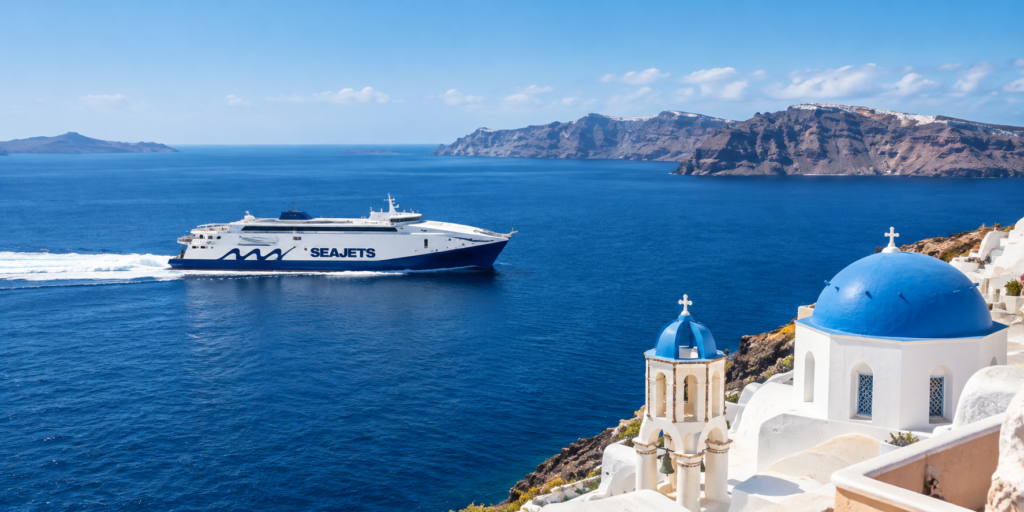
Visiting several Greek islands during one holiday sounds like a dream. Imagine swimming in crystal-clear waters in the morning, exploring a traditional village in the afternoon and enjoying dinner beside the sea in the evening. The challenge is making that dream work without spending too much of your holiday travelling.
Greece has hundreds of islands, and not all of them are connected by convenient, direct ferry routes. Some journeys take less than an hour, while others can require several hours at sea, an early departure or a change of ferry. Connections can also vary depending on the season.
The secret to successful Greek island hopping is simple: choose islands that connect well, plan your route before booking accommodation and avoid unnecessary backtracking.
Here is how to travel between Greek islands more efficiently and make the most of your time in Greece.
1. Choose islands in the same island group
One of the biggest mistakes travellers make is choosing islands based only on photographs or popularity. An island may look close to another on a map, but the ferry network does not always follow the most obvious route.
Greece’s islands are organised into several main groups, including the Cyclades, Dodecanese, Ionian Islands, Sporades and Saronic Islands. Staying within one group—or combining neighbouring destinations with convenient direct connections—usually makes planning easier.
The Cyclades: ideal for first-time island hopping
The Cyclades are among the most popular choices for visitors who want to explore several Greek islands in one trip. The group includes Santorini, Mykonos, Paros, Naxos, Milos, Ios, Syros and many smaller islands.
During the main travel season, several of these islands have direct ferry connections, making it possible to build a route without returning to Athens after every stop.
Good combinations include:
- Paros and Naxos: A practical combination for beaches, traditional villages, food and a relaxed island atmosphere.
- Mykonos and Paros: Suitable for travellers who want nightlife alongside a more laid-back destination.
- Milos and Sifnos: A great option for beautiful coastlines, local cuisine and a slower pace.
- Naxos and Santorini: A contrast between long sandy beaches and dramatic volcanic scenery.
Always check the specific ferry connections for your dates before committing to a route. Not every possible island pairing has a direct service every day.
The Dodecanese: history, beaches and island culture
In the southeastern Aegean, the Dodecanese include Rhodes, Kos, Symi, Patmos, Kalymnos and other islands.
Rhodes can be a useful starting point for exploring this region, while Symi is a popular addition for travellers who want colourful harbour scenery and a smaller-island experience.
This group is worth considering if you want medieval architecture, traditional settlements, swimming and a different atmosphere from the Cyclades.
The Ionian Islands: green landscapes and clear water
On Greece’s western side, the Ionian Islands include Corfu, Kefalonia, Zakynthos, Lefkada, Ithaca and Paxos.
These islands are famous for their green scenery, turquoise water and sheltered coves. However, transport connections vary, and some journeys may require travelling via the mainland or using a combination of ferry and road transport.
For the smoothest trip, check the connections between your chosen islands rather than assuming all of them are linked by direct ferries.
2. Plan your route before booking your hotels
Your route should determine where you stay—not the other way around.
A common mistake is to book accommodation on several islands first and investigate transport later. This can lead to inconvenient departure times, long transfers or unexpected overnight stays.
Instead, follow these steps:
- Choose the islands you genuinely want to experience.
- Check whether direct ferries connect them on your intended travel dates.
- Compare departure times and total journey durations.
- Arrange your overnight stays around the available connections.
- Book accommodation and transport once the itinerary makes sense.
Try to move in one general direction instead of travelling back and forth across the same area.
For example, a route through Paros, Naxos and Santorini may be more convenient than choosing islands in different regions that require you to return to the mainland between stops.
Travel tip: Check the full itinerary before booking non-refundable accommodation. A beautiful hotel is less appealing if reaching it requires losing most of a holiday day.
3. Understand the difference between fast and conventional ferries
Greek island ferries generally fall into two broad categories: high-speed vessels and conventional ferries.
Both can be useful, but the right choice depends on your route, budget and travel preferences.
High-speed ferries
High-speed ferries can significantly shorten some journeys, particularly on busy routes in the Cyclades.
They are useful when:
- You have limited time between islands.
- You want to reach your next destination earlier in the day.
- A shorter crossing allows you to enjoy more time at your destination.
However, faster tickets can cost more, and journey times, comfort and luggage arrangements vary by operator and vessel.
Conventional ferries
Conventional ferries often take longer but can be a comfortable option for longer journeys. Some have outdoor decks, cafés, restaurants and seating areas where you can enjoy the sea views.
They can be a good choice if you have a flexible schedule and prefer to spend less on transport where possible.
The smartest strategy: Compare the total travel time, not just the advertised sailing time. A ferry that arrives earlier may still be inconvenient if it departs from a port far from your accommodation or requires a very early start.
4. Do not underestimate ferry schedules
Ferry schedules are one of the most important parts of planning an efficient Greek island holiday.
Some routes operate frequently during the summer, while others have fewer departures or change according to the season. A connection that works perfectly on one date may not be available on another.
Before booking, check:
- The exact departure and arrival ports.
- Whether the service is direct or includes intermediate stops.
- The scheduled departure and arrival times.
- Whether the route operates on your travel date.
- The luggage and check-in guidance provided by the ferry operator.
For current routes and schedules, consult the ferry operator’s official website or a ferry-search platform such as Ferryhopper. The official regional travel guide at The Aegean Islands is also useful for checking transport information for individual destinations.
Remember that timetables can change, particularly outside the peak summer season.
5. Avoid planning too many islands into one trip
It is tempting to visit as many islands as possible, especially if you are travelling to Greece for the first time. But changing islands involves more than the ferry ride itself.
You need to pack, check out, reach the port, wait for departure, travel, reach your next accommodation and check in again.
Even a relatively short crossing can take up a large part of the day once you include these steps.
As a general planning guide:
- 5–7 days: Choose one or two islands, depending on how easily they connect.
- 8–10 days: Two or three islands can work well.
- 11–14 days: Three or four islands may be realistic with carefully chosen routes.
- Two weeks or more: You can explore a wider area, provided you allow enough time to enjoy each destination.
These are flexible guidelines rather than fixed rules. If you prefer slow travel, fewer islands will usually give you a more relaxing experience.
A useful rule is to spend at least two or three nights on most islands you visit. A single night can work for a specific purpose, but frequent one-night stays often make a holiday feel rushed.
6. Leave enough time between ferries and flights
One of the most stressful travel mistakes is arranging a ferry arrival and a flight departure too close together.
Ferries can be delayed by weather, operational issues or changes to the timetable. If you arrive at an island port and need to catch a flight from its airport, you also need time to travel between the two.
Whenever possible, avoid booking a flight shortly after a ferry arrival on a separate ticket.
If missing the flight would be expensive or disrupt your international journey, consider spending the night near the airport or travelling to the mainland the day before.
The same principle applies to international flights departing from Athens. Returning from an island on the morning of your international flight can be risky, especially during periods of unsettled weather or busy summer travel.
Best practice: Build a buffer into your itinerary rather than assuming every connection will run exactly on schedule.
7. Consider flying for longer distances
Ferries are an essential part of Greek island hopping, but they are not always the fastest option.
Several Greek islands have airports with domestic flights, and some also receive international services. Depending on your destination and travel dates, flying may save you hours compared with a long ferry journey.
Flying is particularly worth comparing when:
- You are travelling between distant regions.
- Your itinerary includes Crete or the Dodecanese.
- You have only a few days available.
- A direct flight avoids several ferry connections.
However, flying is not automatically quicker overall. Consider the time needed to reach the airport, check in, collect luggage and travel to your accommodation after landing.
Compare the door-to-door journey time and total cost, not just the flight duration.
For island pairs with convenient direct ferries, travelling by sea may still be the simplest choice.
8. Travel outside the busiest periods when possible
The timing of your trip can influence both the availability of transport and how relaxed your island-hopping experience feels.
July and August are popular months for Greek island holidays, and many busy routes have frequent ferry services. At the same time, ports, vessels and popular destinations can be crowded.
May, June, September and early October can be attractive alternatives, depending on the island and the kind of holiday you want. Conditions and transport frequency vary, so check your chosen routes before finalising your dates.
During the shoulder season, some services may operate less frequently than in peak summer. That means you should not assume a quieter month automatically makes every connection easier.
For an efficient trip, choose dates and islands together rather than planning them separately.
9. Pack for easy ferry travel
You do not need to pack like a backpacker to travel between islands comfortably, but lighter luggage can make transfers much easier.
Large suitcases are less convenient when you are moving between hotels, ports, taxis and buses. On some vessels, luggage is stored in designated areas rather than beside your seat.
A practical approach is to bring:
- A manageable suitcase or travel backpack.
- A small day bag for valuables and travel documents.
- Sunscreen, water and anything you need during the crossing.
- A light layer for breezy decks or air-conditioned indoor areas.
- Any essential medication and important items in your hand luggage.
Check your ferry operator’s luggage policy before travelling, especially if you are carrying oversized bags or sports equipment.
If you are planning to rent a car, think carefully before taking it between islands. Carrying a vehicle can increase costs and requires checking vehicle availability and booking rules for each sailing. In many cases, it is simpler to rent a car separately on each island.
10. Three efficient Greek island-hopping routes
Here are three itinerary ideas to help you start planning. They are examples rather than guaranteed transport schedules; always verify direct services for your dates.
Route 1: Paros and Naxos — an easygoing island escape
Best for: First-time visitors, couples, families and beach lovers.
Spend a few days exploring Paros, with its traditional villages, seaside restaurants and beaches. Continue to Naxos for long sandy shores, mountain villages and local food.
The two islands are relatively close and have inter-island ferry connections, making them a natural pairing when the available schedules suit your plans.
Suggested duration: 6–8 days.
Route 2: Mykonos, Paros and Santorini — classic Cyclades highlights
Best for: Travellers who want iconic scenery, lively evenings and a variety of island experiences.
Start in Mykonos, continue to Paros and finish in Santorini. This route gives you a mix of nightlife, beaches, traditional settlements and dramatic caldera views.
It is a popular combination, so compare the order of your stops and the ferry times before booking. Depending on your dates, reversing the route may produce more convenient connections.
Suggested duration: 8–10 days.
Route 3: Rhodes and Symi — culture and colourful harbour scenery
Best for: History lovers, photographers and travellers who want to explore the southeastern Aegean.
Use Rhodes as your main base for its medieval Old Town, archaeological sites and beaches. Add Symi for its picturesque harbour, neoclassical buildings and slower pace.
Check the sailing schedule carefully, as the best departure may depend on the day of the week and season.
Suggested duration: 5–7 days.
11. Common island-hopping mistakes to avoid
A few simple decisions can make the difference between a smooth holiday and a stressful one.
Trying to visit too many islands. More destinations mean more transfers and less time to explore.
Booking accommodation before checking transport. Confirm that the route works before committing to non-refundable stays.
Assuming every island has a direct connection. Some journeys require a change of ferry or a mainland transfer.
Ignoring the port location. Greece has several mainland departure ports, and the most convenient one depends on your destination and starting point.
Planning tight connections. Leave enough time between ferries, flights and other important commitments.
Assuming summer timetables apply all year. Seasonal routes and departure frequencies can vary.
Forgetting the return journey. Plan how you will reach your final destination and get back to your international departure point.
12. How to book Greek island ferries efficiently
Once your route is decided, compare your options before buying tickets.
You can search for ferry journeys using platforms such as Ferryhopper or check individual operators’ websites for schedules, fares, luggage information and booking conditions.
Before paying, confirm that the selected sailing is direct if that is important to you. Check the departure port, arrival port, travel date, passenger details and ticket conditions.
For busy summer dates, popular routes and peak travel weekends, booking ahead is sensible. If you are travelling during quieter months, check whether your route operates on the dates you need rather than assuming daily service.
Keep your booking confirmation accessible, and check for operator updates before departure.
Frequently asked questions
What is the easiest way to travel between Greek islands?
For many island-hopping trips, ferries are the easiest option, particularly when you choose islands with direct connections. For longer distances, compare flights with ferries to find the best overall journey.
How many Greek islands can I visit in one week?
For a comfortable seven-day holiday, one or two islands is usually a sensible choice. You may be able to visit more, but frequent transfers can take time away from sightseeing, beaches and relaxing.
Do I need to book Greek ferry tickets in advance?
Booking in advance is recommended for popular routes and busy summer dates, especially if you have a fixed itinerary. For other journeys, availability and the need to book early depend on the route, season and type of ticket.
Can I travel directly between all Greek islands?
No. Many islands have direct connections to selected destinations, but the network is not a complete grid. Some journeys require a change of ferry or travel via the mainland.
Are fast ferries always better?
No. Fast ferries can save time, but they may cost more. Compare the full journey, ticket price, departure time and arrival arrangements before deciding.
Is it better to fly or take a ferry between Greek islands?
It depends on the distance and the available connections. Ferries are often practical for neighbouring islands, while flights may save time on longer journeys. Compare door-to-door time and cost for your specific route.
What happens if my ferry is delayed?
Follow the ferry operator’s announcements and check your booking information for updates. If you have a connecting flight or another important booking, leave a generous buffer and avoid relying on a tight same-day connection whenever possible.
When is the best time for island hopping in Greece?
Late spring and early autumn can offer a good balance of pleasant weather and a less intense travel atmosphere. Summer is also popular, but transport and accommodation can be busier. Always check seasonal ferry schedules for your chosen islands.
Final thoughts: travel smarter, not faster
The best Greek island-hopping itinerary is not necessarily the one that includes the most destinations. It is the one that gives you enough time to enjoy each place without spending your holiday rushing between ports.
Choose islands that connect well, check ferry schedules before booking accommodation, allow time for delays and consider flying when distances are long. Most importantly, leave room for the experiences that make Greece special: a long seaside lunch, a hidden beach or an evening wandering through a traditional village.
With a little planning, travelling between Greek islands can become a memorable part of your holiday rather than a logistical challenge.
Ready to plan your Greek island adventure? Start by choosing the islands you most want to see, then build your route around the connections that work best for your dates.
Ready to join the elite group of travelers discovering Greece on their own terms? We invite you to explore our bespoke travel packages for more inspiration. If you desire a personalized plan, please contact our luxury travel experts today.
Before you book your session, make sure to check the weather forecast for Greece to ensure a clear sky